近日,课题组硕士生张玲论文“High-efficiency CO2 separation in Li-functionalized 3D MOFs: Synergy of interpenetration degree and polarity”被Separation and Purification Technology(二区TOP,IF=9.0)接收!
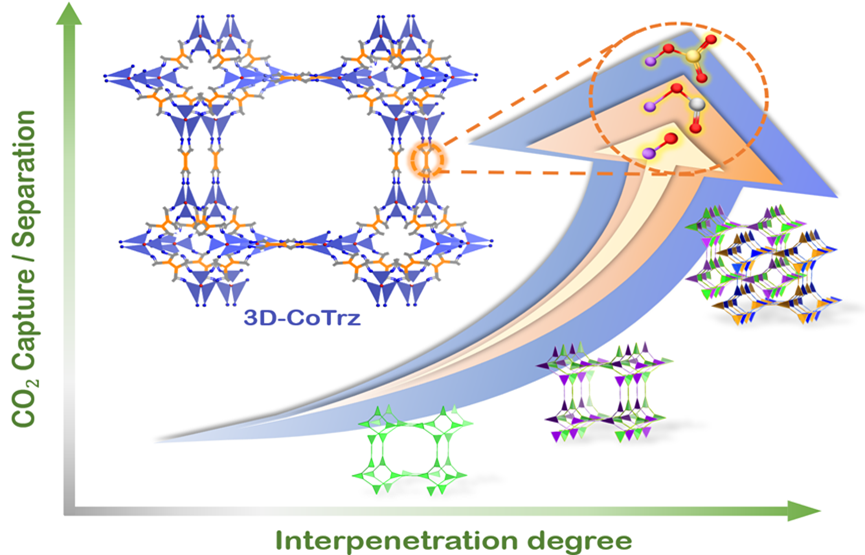
Abstract
Metal-organic frameworks (MOFs) with outstanding adsorption performance have attracted considerable interest for mitigating atmospheric CO2 emissions. By introducing different interpenetration degrees and Li-containing functional groups onto the linker of a 2D MOF (CoTrz-0), a series of 3D isoreticular MOFs (CoTrz-f-nh, functional groups f = –OLi, –COOLi, and –SO3Li; interpenetration degree n = 1, 2, and 4) were constructed by altering the linker orientation. The 3D framework overcomes interlayer spacing constraints, with the interpenetration-regulated microporous environment determining CO2 adsorption and separation performance. Quadruple interpenetration creates an optimal pore structure that combines high-density adsorption sites with high surface area, substantially enhancing adsorption capacity and selectivity. Within this optimized environment, the –SO3Li group, possessing the greatest polarity, provides the greatest enhancement for CO2 adsorption. The best-performing material, CoTrz-SO3Li-4h, exhibits a CO2 uptake of 155.37 cm3/cm3 and CO2/N2 and CO2/CH4 selectivities of 1016.82 and 653.01, respectively, at 298 K and 100 kPa. To elucidate the underlying mechanism, Grand Canonical Monte Carlo (GCMC) simulations and Density Functional Theory (DFT) calculations were performed, revealing the adsorption site distribution, electrostatic potential (ESP), isosteric heat of adsorption (Qst), and the interactions between CO2 and the framework. This work demonstrates a synergistic strategy of interpenetration and polar-site engineering to advance MOF-based CO2 capture and separation.
https://doi.org/10.1016/j.seppur.2026.137962
